
Why traditional crafts still matter in a changing world
Never stop learning, creating and sharing knowledge
From learning crochet as a child to sharing handmade skills online, I reflect on why sewing, crochet and lifelong learning remain valuable in an ever-changing world.

Learning, creating and passing knowledge from one generation to another.
Technology continues to change the way we live, work and communicate. We can buy ready-made clothing, household decorations and almost anything we need with just a few clicks. With so much convenience available, it's reasonable to ask whether traditional skills such as crochet, sewing and dressmaking still have a place in modern life.
I believe they do.
For me, learning to make something from scratch is about more than producing a finished item. It is about developing knowledge, patience, creativity and confidence. These are things we can carry with us throughout our lives.
Learning new skills is like collecting treasures that nobody can take away from you.
That belief comes from my own experiences, beginning many years ago when I was growing up in the Philippines.
The skills we learn can stay with us for life
When I was in secondary school, we were required to choose an extracurricular course. My first choice was Advanced Biology, but the class was already full.
I ended up taking Fundamentals of Dressmaking.
At the time, I was disappointed. I wanted to study Biology, not dressmaking. Although sewing was familiar to me from childhood, I had never imagined it would become such an important part of my creative life.
Our lessons were mainly about taking measurements, understanding garment construction and making patterns. We didn't spend all our time sewing.
I remember wondering whether I would ever need this knowledge.
Looking back, I'm glad I had the opportunity to learn it.
As we grow older, we may forget some of the finer details of a subject, especially when we haven't practised it for years. But the understanding we gained can remain with us.
We might need to refresh our memory or learn a technique again, yet we are not necessarily starting from nothing.
Sometimes the skills we never intended to learn become useful much later in life.
Learning practical skills at a young age
Sewing was part of my childhood. I grew up surrounded by people who understood the value of making and repairing things by hand.
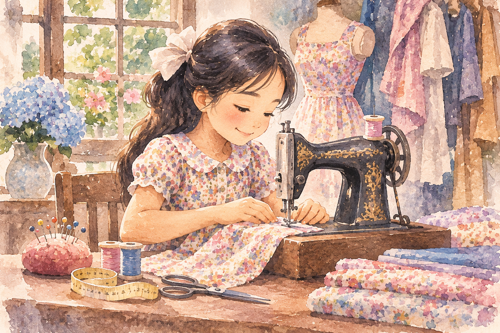
When I was young, I had opportunities to learn how to operate both manual and industrial sewing machines. I also gained practical experience helping a neighbour who ran a sewing business.
We made children's trousers using leftover fabric from garment production. The finished clothing was intended for charitable purposes.
It wasn't glamorous work, but it taught me something valuable.
Materials that might otherwise have been discarded could become useful garments. A skill learned through practice could also provide opportunities that we might not have expected.
The dressmaking knowledge I gained at school eventually helped me understand how to make a simple skirt pattern.
I didn't realise it then, but these experiences were teaching me resourcefulness, independence and the value of making things with my own hands.
My first experience of learning crochet
My interest in crochet began when I was about ten years old.
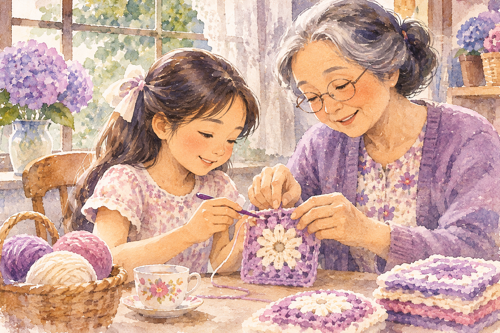
I remember watching a neighbour making a decorative table covering from an old flour bag.
The bag was made from a linen- or cotton-like fabric, with the original branding still printed on it. My neighbour didn't seem concerned about the printing. She simply prepared the fabric, sewed its edges and added a beautiful crocheted border.
I was fascinated.
Something ordinary, which many people might have thrown away, was being transformed into something useful and decorative.
I wanted to learn how to do it myself.
My neighbour encouraged my interest, and I began learning by watching and practising.
Learning wasn't easy at first.
I remember struggling just to make a foundation chain. My tension was so tight that I couldn't work the next stitch properly.
Anyone who has tried crochet for the first time may recognise that frustration.
But I kept trying.
What began as curiosity eventually became a skill I would carry into adulthood.
Looking back, I realise that my neighbour gave me more than an introduction to crochet. She showed me how knowledge could be shared through patience, observation and encouragement.
From learning beside a neighbour to learning online
When I first learned crochet, there were no YouTube tutorials to watch.
If you wanted to learn something, you might ask a family member, a neighbour or someone in your community who already knew how to do it.
You watched their hands, listened to their explanations and tried to repeat what they demonstrated.
Sometimes you made mistakes, and someone was there to help you understand what went wrong.
Today, technology has made learning accessible in ways I could never have imagined as a child.
Someone interested in crochet can search for a tutorial, watch a technique being demonstrated and replay the instructions as many times as necessary.
A person who doesn't know anyone locally who crochets can still begin learning at home.
Of course, watching a video isn't quite the same as sitting beside someone who can guide your hands or help correct your tension. Both ways of learning have their advantages.
But the principle remains remarkably similar.
Someone has knowledge. Someone else wants to learn. And a connection is made between them.
What began for me as a lesson between a neighbour and a young girl can now become a learning experience shared with people across the world.
That is one of the things I value most about creating tutorials for Crafting with Beth.
Traditional crafts don't need to belong to the past
Sometimes crochet, sewing and other traditional crafts are associated with older generations.
And perhaps that is understandable. Many of us remember parents, grandparents or neighbours who could sew, knit, crochet or repair things around the home.
But I don't believe these skills should belong to any particular generation.
People learn crafts for different reasons.
Some enjoy making clothing or decorations that reflect their personal style. Others appreciate the satisfaction of creating something from scratch. Some want to reuse materials, repair possessions or develop a relaxing creative hobby.
For others, practical skills may even open opportunities to earn additional income.
There is no single reason to learn crochet or sewing, and there doesn't need to be.
Not everyone will be interested in handmade crafts. That's perfectly fine.
What matters is that the opportunity to learn remains available to those who are curious.
Traditional skills don't need everyone to practise them. They need people who are willing to learn, people who are willing to teach and communities where that knowledge can continue to grow.
Creativity and technology can exist together
My professional background is in computer programming and web development, so technology has always been an important part of my working life.
At the same time, I still enjoy crochet, sewing and making things by hand.
To me, there is no contradiction between the two.
Technology helps us communicate, organise information and reach people who may live thousands of miles away.
Traditional crafts give us opportunities to work with physical materials, develop practical techniques and enjoy the process of creating something ourselves.
One doesn't have to replace the other.
In fact, technology can help traditional crafts survive.
A crochet technique once shared between neighbours can now be recorded, explained and made available to learners around the world.
Written tutorials, photographs and videos can help preserve knowledge and make it easier for future generations to discover.
The tools we use to teach may change, but the value of sharing what we know remains.
Lifelong learning is for everyone
One belief has stayed with me throughout my life:
Never stop learning.
Sometimes we choose what we want to learn. Other times, circumstances take us in directions we never expected.
I didn't choose dressmaking as my first preference at school. I didn't know that watching a neighbour crochet would become the beginning of a lifelong interest.
Yet those experiences became part of who I am.
Learning doesn't have to end when we leave school, complete a qualification or begin working.
We can continue learning at any age, whether that means mastering a new crochet stitch, understanding how to draft a sewing pattern, learning to use new technology or trying something completely unfamiliar.
Of course, people have different responsibilities and opportunities. Work, family commitments and everyday life can make finding time to learn difficult.
But learning doesn't always require a formal course or a large commitment.
Sometimes it begins with a few minutes of curiosity and a willingness to try.
And even when a new skill doesn't seem immediately useful, we cannot always predict where it might lead.
Keeping handmade traditions alive for future generations
My hope for Crafting with Beth is to help create a community of people who share an interest in handmade crafts and lifelong learning.
I want people to feel encouraged to try something new, whether they're making their first crochet chain or returning to sewing after many years.
I also hope that the knowledge shared today will remain useful to future generations.
When I was young, I learned from people in my local community. Now, through my website and tutorials, I have an opportunity to share those experiences with a much wider audience.
Perhaps someone will learn a stitch from one of my tutorials and eventually teach it to a friend, a child or a grandchild.
Perhaps they will develop their own techniques, create something entirely new or simply discover the pleasure of making things by hand.
That is how knowledge continues.
Technology will undoubtedly keep changing our lives. We cannot know exactly what the future will look like.
But I hope there will always be a place for handmade things, practical skills and the quiet satisfaction of creating something ourselves.
And if I could encourage someone, especially a young person, to remember just one thing, it would be this:
Never stop learning.
You may not know today where a new skill will take you. You may struggle at first, make mistakes or wonder whether the effort is worthwhile.
But every skill you learn gives you another possibility.
And when you have the opportunity, share what you know.
Someone else might need that knowledge one day.