
Learning transfer: How knowledge travels through time and space
From watching neighbours practise traditional crafts to sharing tutorials across the world, knowledge has always travelled between people and generations. Through families, schools, communities and modern technology, learning transfer continues to shape how we create, preserve and develop practical skills.

Throughout human history, knowledge has travelled from one person to another. Sometimes it has been carefully taught, documented and preserved. At other times, it has passed almost unnoticed through everyday activities, observation and experience.
A child watches a neighbour crochet. A parent demonstrates how to mend a torn garment. A teacher introduces students to unfamiliar materials and techniques. A craftsperson shares a method developed through years of practice.
These ordinary encounters are examples of learning transfer.
The ways we acquire and share knowledge have changed considerably over time. Today, we have access to digital libraries, instructional videos, online communities and artificial intelligence. Yet long before these technologies existed, people were already learning from one another.
Traditional crafts offer an interesting way to explore this continuity.
In my previous article, How did crochet survive the chaos of history?, I reflected on how a familiar craft endured through periods of historical change.
This time, I want to look beyond crochet itself and consider a broader question: how does knowledge continue to travel through generations, societies and changing technologies?
How did people learn traditional crafts before modern technology?
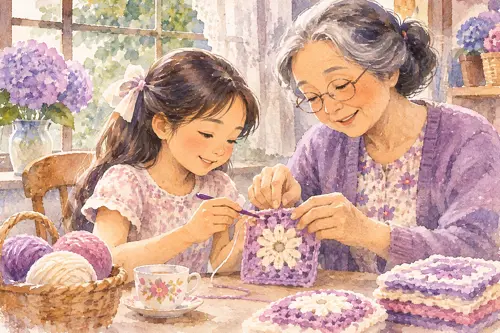
Before instructional videos, online tutorials and digital patterns became widely available, many practical skills were learned through direct observation.
Children grew up surrounded by adults who made, repaired and adapted things for everyday use. Skills were demonstrated in homes, workshops, farms and neighbourhoods, often without any formal teaching arrangement.
Growing up in the Philippines, I remember neighbours practising different kinds of handmade crafts.
One neighbour made miniature cooking pots and kitchen utensils from clay. The small pieces were shaped by hand and fired, creating toys that children could use in imaginative cooking games.
Another neighbour worked with small pieces of fabric, sewing hexagonal shapes together to create useful household coverings.
These activities were part of ordinary neighbourhood life. Some people made things for their own homes, while others used their skills to earn an income.
Looking back, I realise that simply being surrounded by these activities was an opportunity to learn.
Not every observation became a skill I would eventually practise. Nevertheless, those experiences introduced me to the possibilities of working with different materials.
They also demonstrated something important: knowledge does not always require a formal classroom to move from one person to another.
Sometimes, learning begins simply because someone is making something nearby.
What role do families and communities play in passing on skills?
Families and communities have long provided opportunities for informal learning.
A child might watch a grandparent prepare food, observe a neighbour repairing furniture or help a parent sew a garment. Over time, repeated exposure can develop into familiarity, curiosity and practical ability.
In some households, particular skills become family traditions. In others, knowledge is shared more widely through neighbours, friends and local craftspeople.
The process is not always deliberate.
Someone making a quilt may be concentrating entirely on the work rather than thinking about teaching the next generation. Yet a child watching the process may remember how the pieces were arranged, how the fabric was handled or how the finished item gradually took shape.
This is one of the interesting characteristics of informal learning: knowledge can be encountered even when nobody has organised a lesson.
However, observation alone does not guarantee that a skill will be acquired. People also need opportunities to practise, ask questions, make mistakes and develop confidence.
Communities provide more than technical demonstrations. They can create environments in which making things feels familiar, achievable and worthwhile.
For someone growing up in such an environment, creativity may become part of everyday life rather than a separate activity reserved for special occasions.
How does education contribute to learning transfer?
Schools provide another important pathway through which practical and creative knowledge can be introduced to younger generations.
My primary school education included art lessons involving a variety of materials and techniques.
I remember covering an entire sheet of paper with colourful crayons before applying a black layer over the surface. Once it had dried, we scratched shapes and patterns into the dark covering, revealing the colours underneath.
This technique is commonly known as crayon scratch art.
Another activity involved crushing dried eggshells into small pieces. We applied glue to selected areas of a drawing, sprinkled the crushed shells over the adhesive and painted the textured surface.
I remember creating a picture of Snow White using this technique.
These were enjoyable childhood activities, but they also encouraged experimentation.
We learned that ordinary materials could be transformed into something creative. We explored texture, colour, composition and different ways of producing an image.
Later, during high school, I encountered sewing and embroidery through the curriculum.
Education introduced techniques that might otherwise have remained unfamiliar to me.
Not every activity became a lifelong interest, but each experience contributed to a broader understanding of what could be made by hand.
This is one of the lasting values of creative education.
A student does not necessarily need to become an artist, dressmaker or craftsperson for those lessons to have been worthwhile.
The opportunity to experiment, solve problems and work with materials can remain valuable regardless of the profession that student eventually chooses.
Why do some creative skills become lifelong interests?
People encounter many activities throughout childhood, but only some develop into lasting interests.
For me, crochet was one of those skills.
I learned largely through observation, experimentation and practice. Watching others helped me understand the movements involved, while repeated attempts allowed me to develop my own ability.
Although I encountered several forms of art and craft, crochet continued to attract my attention.
Sewing also remained part of my life, particularly through small quilting projects, embroidery and practical activities such as mending clothes.
Other childhood activities became pleasant memories rather than regular pursuits.
Why does this happen?
Personal interest is certainly important, but several other factors can influence whether someone continues practising a skill.
Access to materials, opportunities to practise, encouragement from others and the satisfaction of completing a project can all contribute.
Sometimes a craft provides a practical benefit. At other times, the process itself becomes enjoyable.
For some people, making something with their hands offers a welcome change from their everyday responsibilities.
For others, it becomes a way to express creativity, develop expertise or connect with people who share similar interests.
A skill first encountered in childhood can therefore remain relevant throughout adulthood, even when it has little connection to someone's professional occupation.
Can encouragement influence whether a skill survives?
Learning a technique is one thing. Developing the confidence to continue practising it is another.
I remember a teacher who recognised my ability in crochet and nominated me to participate in a competition.
I also enjoyed creative competitions that required participants to produce something within a limited time.
Those experiences provided opportunities to challenge myself and develop confidence in my abilities.
Looking back, I appreciate the importance of encouragement.
A teacher may introduce a skill to many students, but recognising an individual's interest or ability can provide an additional reason to continue.
The same principle applies outside formal education.
A parent who praises a child's handmade project, a neighbour who patiently demonstrates a technique or a friend who offers constructive advice may influence someone's willingness to keep learning.
Encouragement does not necessarily create an interest where none exists. However, it can help someone recognise possibilities they might not otherwise have considered.
This is an important part of learning transfer.
Passing on knowledge involves more than explaining how something is done. It can also involve helping another person believe that they are capable of doing it.
Are younger generations still learning practical creative skills?
It is easy to assume that traditional craftsmanship is disappearing because younger generations have different interests and opportunities.
However, practical creativity extends far beyond familiar textile crafts such as crochet, knitting and sewing.
Carpentry, woodworking, electronics, gardening, farming, construction and mechanical repairs all involve knowledge developed through observation and experience.
Different generations may encounter these skills in different ways.
Some young people learn through school subjects and organised activities. Others develop an interest through family members, hobbies, community projects or online resources.
Social expectations have also influenced which activities people are encouraged to pursue.
Historically, certain crafts were associated more strongly with women, while others were associated with men. These distinctions have varied between cultures and periods, and they do not determine an individual's abilities or interests.
Today, people have opportunities to explore a much wider range of activities.
Someone interested in fashion might learn dressmaking or textile design. Another person might enjoy building furniture, repairing electronics or growing food.
The materials and techniques may differ, but the underlying process remains familiar.
People observe, experiment, practise and gradually improve.
Perhaps the more useful question is not whether younger generations are learning exactly the same crafts as their predecessors.
It is whether they continue to have opportunities to discover the satisfaction of making, repairing and creating things for themselves.
How have necessity, livelihood and leisure changed the role of craftsmanship?
Traditional craftsmanship has served different purposes throughout history.
For many households, making and repairing things was once an everyday necessity.
Clothes were mended to extend their useful life. Fabric remnants could be transformed into household items. Furniture and tools were repaired when replacement was difficult or expensive.
Practical skills could also provide an income.
Someone who became proficient at sewing, pottery, carpentry or another craft might produce goods or offer services to people within the community.
Those skills could eventually develop into a livelihood.
Modern life has changed how many people obtain the things they need.
With demanding work schedules and access to manufactured products, it is often more convenient to purchase an item or pay a specialist to make or repair it.
Yet this does not mean the underlying knowledge has disappeared.
In some cases, skills that were once practised within households have become specialised professions or commercial services.
Necessity also continues to encourage learning.
Someone who cannot afford a repair service may decide to investigate the problem and attempt the work themselves, provided it can be done safely.
At the same time, many people practise crafts for enjoyment rather than necessity.
They purchase yarn, fabric, tools and equipment because they appreciate the experience of making something.
Modern craft shops, specialist suppliers and online marketplaces continue to serve people interested in handmade activities.
These different motivations often overlap.
A hobby can develop into a business. A practical repair can inspire a new interest. Someone who begins making things to save money may discover that they enjoy the creative process.
Craftsmanship has therefore not simply moved from necessity to leisure.
It continues to exist as a combination of practical knowledge, economic activity, personal interest and creative expression.
Does technology replace traditional craftsmanship or help it evolve?
Technology is sometimes presented as the opposite of traditional craftsmanship.
Yet the relationship between the two is more complicated.
Consider wool production.
A farmer raising sheep may shear the animals and send their fleece to a specialist processing mill.
There, machinery can assist with washing, carding, spinning and other stages involved in producing yarn.
Modern equipment can improve consistency, efficiency and productivity. Appropriate processes can also support better working conditions, hygiene and quality control.
However, some producers continue to process wool by hand.
They may wash and card fleece themselves, spin yarn using traditional equipment or experiment with hand-dyeing techniques.
Both approaches involve knowledge of the material.
The difference lies partly in the tools, scale and methods used.
A person crocheting with commercially produced yarn is still practising a handmade craft, even though machinery may have been involved in producing the fibre.
Similarly, a craftsperson using modern equipment does not necessarily abandon traditional knowledge.
Technology can reduce repetitive labour, improve precision and make materials or techniques more accessible.
It can also introduce new possibilities.
Computer-controlled cutting equipment, digital sewing patterns, electronic knitting machines and modern woodworking tools demonstrate how established crafts can develop alongside technological innovation.
The important distinction is between the knowledge required to understand a process and the equipment used to perform it.
Preserving traditional craftsmanship does not necessarily mean rejecting modern tools.
It means recognising the value of practical knowledge while allowing methods to evolve.
From neighbourhood demonstrations to a worldwide network
Technology has also transformed how knowledge is shared.
When I was young, I learned crochet partly by observing people around me.
Today, I find myself in a similar position to those who demonstrated their skills to me.
The difference is the medium.
As a web developer and lifelong crafter, I can combine my technical knowledge with my interest in traditional craftsmanship.
Through Crafting with Beth, I use written tutorials, photographs, videos and a website to share techniques with people who may live thousands of miles away.
Artificial intelligence can also assist with organising information, developing content and supporting the technical work involved in maintaining a digital platform.
These tools do not replace the practical experience accumulated through years of making things.
Instead, they help me communicate and distribute that knowledge.
Someone learning a crochet stitch today can pause a video, repeat a demonstration or consult written instructions whenever necessary.
Although this differs from sitting beside an experienced craftsperson, it provides opportunities that were not previously available to many learners.
A technique once demonstrated within a small neighbourhood can now be shared across countries, cultures and generations.
Technology changes the reach of learning transfer, but the fundamental relationship remains recognisable.
Someone knows how to do something, and someone else wants to learn.
How can knowledge continue through time and space?
In my previous article about crochet surviving the chaos of history, I considered how a traditional craft continued despite the many changes experienced by human societies.
The survival of a craft depends, in part, on people continuing to practise and share its techniques.
Knowledge can travel through time when one generation teaches another.
It can travel across geographical distances through migration, cultural exchange, written records and communication technologies.
Today, digital media allows information to reach people almost immediately, regardless of where it was originally created.
However, knowledge is not guaranteed to survive simply because it exists.
Skills can disappear when they are no longer practised. Techniques may be forgotten when experienced craftspeople have nobody to teach. Digital information can also become inaccessible when platforms disappear, files are lost or technologies become obsolete.
This makes the continued practice, documentation and sharing of knowledge important.
A written pattern may preserve instructions. A photograph may record a particular stage of construction. A video can demonstrate movements that are difficult to explain through words alone.
Each method contributes something different.
Yet documentation is only one part of the process.
Knowledge remains meaningful when people engage with it, test it, adapt it and apply it in their own lives.
The neighbour who demonstrated crochet during my childhood could not have known that, decades later, I would be sharing similar skills through a website and video tutorials.
Nor can I know who might encounter those tutorials in the future.
Perhaps someone will learn a stitch, create a handmade item and eventually demonstrate the same technique to another person.
That person may develop a new method, adapt the pattern or combine it with ideas from another tradition.
In this way, knowledge does not simply remain unchanged.
It continues to develop as people learn from one another.
A tradition that continues
The tools we use to share knowledge will continue to change.
The neighbourhood demonstrations of my childhood are now accompanied by online tutorials, digital publications and technologies that connect people around the world.
Future generations may develop methods of learning that we cannot yet imagine.
But the principle behind learning transfer is much older than any particular technology.
Human beings observe, question, experiment, practise and share what they discover.
As long as people continue to value learning and pass on what they know, there is an opportunity for knowledge to travel further.
We cannot preserve every skill or predict how future generations will use what we leave behind.
But we can contribute to that continuity.
Every technique we demonstrate, every experience we document and every person we encourage gives knowledge another opportunity to survive.
Knowledge travels through time and space, not because it remains untouched, but because people continue to learn, practise and share it.
And perhaps that is one of the most enduring traditions of all.